
Grainger County Release Meaning
A release closes one custody episode. It does not always mean the person went home. The Grainger County Detention Facility may release someone on bond, after time served, under a court order, when a sentence expires, or into probation after a split sentence. It may also transfer a person to the Tennessee Department of Correction, another county, the U.S. Marshals Service, or immigration custody. Death can end a jail record as well. The destination and release authority determine what happened next.
That distinction matters because each agency keeps its own record. The Grainger County Sheriff’s Department documents the local booking and movement. The Circuit Court Clerk keeps the order, judgment, bond action, or disposition that supplied legal authority. TDOC records a felony sentence and later prison or supervision status. Federal systems cover their own custody. A complete Grainger County release check identifies which facility stopped holding the person, when the event occurred, why it occurred, and whether another agency received custody.
- Community release
- The person leaves confinement without an immediate custodial handoff, though supervision or court duties may continue.
- Transfer
- One agency ends custody because another agency receives the person.
- Discharge
- A defined custody or supervision obligation ends under the controlling record.
- Time served
- The court credits enough lawful custody to satisfy the confinement ordered in that case.
Grainger County Release Types
Grainger County release terms should be read with the destination field, court file, and later status. A bond amount on the booking page shows a condition that could allow release. It does not show that the bond was posted. Probation may follow a short jail term, while parole follows imprisonment and requires a Board decision. A local jail exit to TDOC closes the county booking but continues confinement.
| Release or movement | What it means | Best next record |
|---|---|---|
| Bond or court order | The jail acts on valid authority after conditions are met. | Jail movement entry and court order |
| Time served or expiration | The confinement term for that custody episode ends. | Judgment, credit record, and actual release entry |
| Probation | The court places the person under community supervision, sometimes after split confinement. | Court judgment, FOIL, and field office |
| Parole | The Board permits conditional release from prison after required steps. | FOIL, Board record, and TDOC authorization |
| Transfer or detainer | Grainger custody ends but another agency takes custody. | Movement destination and receiving locator |
| Dismissal | A charge ends, but another case or hold may remain. | Court disposition and jail confirmation |
Use exact words from the record. “Inactive” in FOIL concerns TDOC custody or supervision. “Out on Bond” has a different meaning. “Incarcerated” defeats a claim of community release from state custody, and “in transit” does not mean federal release.
Grainger County Release Record Fields
The public Grainger jail detail is strong at tying a person to a booking. It can display Name ID, age, race, sex, address, admission date and time, confining agency, charges, court and offense dates, bond, bond type, and the charging and arresting agencies. A booking photograph may appear. Yet the inspected display did not label the release date, time, reason, or destination. “Admit Date” is not a release field.
| Requested field | What it establishes |
|---|---|
| Name ID or booking number | Connects the request to the correct Grainger booking. |
| Admission date and time | Identifies when this custody episode began. |
| Release date and time | Shows when physical Grainger custody ended. |
| Release code or authority | Identifies bond, order, completion, transfer, or another basis. |
| Destination | Separates community release from a custodial handoff. |
| Releasing officer or entry | Links the action to the jail-management record. |
| Property disposition | Records how held property was processed, if maintained. |
Request Grainger County Release Records
The Grainger County Sheriff’s Department is the first custodian for a recent jail movement record. Its current address is 270 Justice Center Drive, Suite 105, Rutledge, TN 37861, and its main number is 865-828-3613. County sources conflict on the detention mailing box and fax. Call before mailing. Do not use the legacy jail listing that points to Newport, because the research found it conflicts with the current Grainger sheriff source.
- Identify the person by full name, spelling, date of birth if known, approximate admission date, and Name ID or booking number.
- Ask for the booking sheet, movement or release entry, exact date and time, release authority or code, destination, and booking photograph.
- Request an electronic copy and a written estimate. Ask the custodian to redact exempt material and release the remaining portions.
- If another office holds part of the record, request a referral. Pair the jail entry with the court order or TDOC record as needed.
- Keep the response, request date, agency contact, and field labels together so later status changes are clear.
Tenn. Code Ann. § 10-7-503 provides Tennessee citizens access subject to exemptions and agency rules. If records cannot be produced promptly, the custodian generally has seven business days to produce them, deny the request with a legal basis, or state the reasonable time needed. Inspection ordinarily carries no charge. Copies and labor may cost money. The state safe-harbor schedule lists fifteen cents per standard black-and-white page and fifty cents per color page, but Grainger publishes no sheriff-specific schedule. Ask first.
Older permanent records may be referred to Grainger County Archives at 7850 Rutledge Pike. Recent release questions still begin with the sheriff. A TDOC discharge requires the TDOC public-records process, not a county request.
Grainger Release Records Next Door
The sheriff and Circuit Court Clerk share 270 Justice Center Drive, but their records are not interchangeable. The Sheriff’s Department occupies Suite 105 and documents custody movement. The clerk works from Suite 114 and maintains the court’s legal disposition. That close physical location can cause confusion, yet the two offices answer different questions and use different phone numbers.
Start with the booking detail’s Court Type. Grainger publishes separate Circuit Criminal and General Sessions Criminal dockets. The Grainger County court portal helps locate the right division, while the order, judgment, or disposition supplies the legal basis. A docket date is merely a scheduled court event. It is not the time a person walked out of the jail. Pair the court document with the sheriff’s movement entry.
Which Grainger Jail Released Them?
The operating jail is the Grainger County Detention Facility at the Justice Center. County material says the current Justice Center opened in 2005 and reports a 104-bed jail. A separate county notice from 2025 discusses grant funding for the Old Grainger County Jail and Veteran’s Island Park. That old building is a historic site, not a current custody search target.
The county’s old-jail notice helps distinguish the two places. Search requests should name the current Detention Facility and the relevant booking date. Its release record should also identify any transfer destination.
Note: The historic jail is not a second facility and does not add another current roster, release feed, or records counter.
Expunged Grainger Release Records
An expungement begins with the court. Tennessee materials state that an expungement order is sent to the arresting agency, county jail, TDOC, and TBI. One valid order can therefore change several public results. An older Grainger booking may vanish from more than one system after the agencies process that order. A no-result response is not proof that no custody event ever occurred.
The Tennessee courts expungement resource describes court-approved routes and forms. Eligibility depends on the case result, offense, sentence completion, waiting period, and current law. Dismissal, not guilty, no true bill, nolle prosequi, or arrest and release without charge may fall into different rules than an eligible conviction. The court handles the order. The sheriff corrects booking or movement facts, while TDOC corrects FOIL information.
Juvenile, medical, victim, personal, security, sealed, and expunged material can be withheld under specific protections. A focused request should ask for the nonexempt remainder rather than assume the entire file must be public.
Find Grainger County Released Inmates
The safest lookup follows custody type. Grainger’s live portal is useful for identity, admission, charge, court, bond, agency, and photo fields. Its code contains route names that appear to concern released records, but direct testing found the current and purported released grids showing the same count and current-style fields. Neither displayed a release date. The route label alone cannot prove release.
- Search the Grainger jail interface by name. Compare age, admission date, court type, charge, and agencies before accepting a match.
- Check whether the person is still returned in the current view. Do not treat disappearance or an “Admit Date” as release proof.
- Call the Detention Facility or request the movement entry for exact time, reason, and destination.
- Use TDOC FOIL if a felony sentence or transfer may place the person in state custody or supervision.
- Match the Grainger court order or judgment. It can explain bond, dismissal, sentence, probation, or revocation.
- Use VINE for custody events, BOP for federal sentences, and ICE only when an immigration transfer is at issue.
The official Grainger County Sheriff page links both the jail interface and Tennessee VINELink. Start there instead of relying on a copied address or an unexplained route.
Grainger County Recent Release Limits
Grainger County does not publish a verified rolling 24-hour or 72-hour release list. The public jail interface includes a number-of-days control, but research did not establish that it filters releases. It may filter admissions or current bookings by recency. The server does not publish an update schedule, timezone rule, or retention period.
A same-day inquiry should call 865-828-3613 and ask for the exact movement record. A three-day inquiry should identify the three calendar dates in the request. Court records can then confirm the legal authority. Future custody events may be tracked through VINE. The Grainger County 24-hour release list page gives the fallback in same-day order and explains why the apparent released endpoints are not treated as a feed.
Note: A dynamic page can refresh often while still lacking a dependable release field, archive window, or stated update promise.
TDOC Search for Grainger Releases
TDOC’s Felony Offender Information Lookup, called FOIL, covers people currently or formerly in Tennessee felony custody or supervision. A Grainger misdemeanor or pretrial booking may never appear. Search with a State ID or TDOC ID when known. Name results should be matched through photo, age or identifiers, offense, sentence information, and status.
| FOIL item | How to read it |
|---|---|
| TDOC ID or State ID | The strongest public search key when available. |
| Incarcerated | The person remains in state confinement or an associated placement. |
| Parole or Probation | The person is in the community under TDOC supervision. |
| Inactive | Active TDOC custody or supervision ended; check dates and sentence details. |
| Sentence End Date | The stated end of state supervision or incarceration, subject to lawful calculation. |
| Parole Eligibility Date | The earliest consideration point, not a promise of release. |
The TDOC FOIL search form is the persistent state route for a Grainger felony case. The official interface below shows the search channel that separates state custody from a county jail episode.
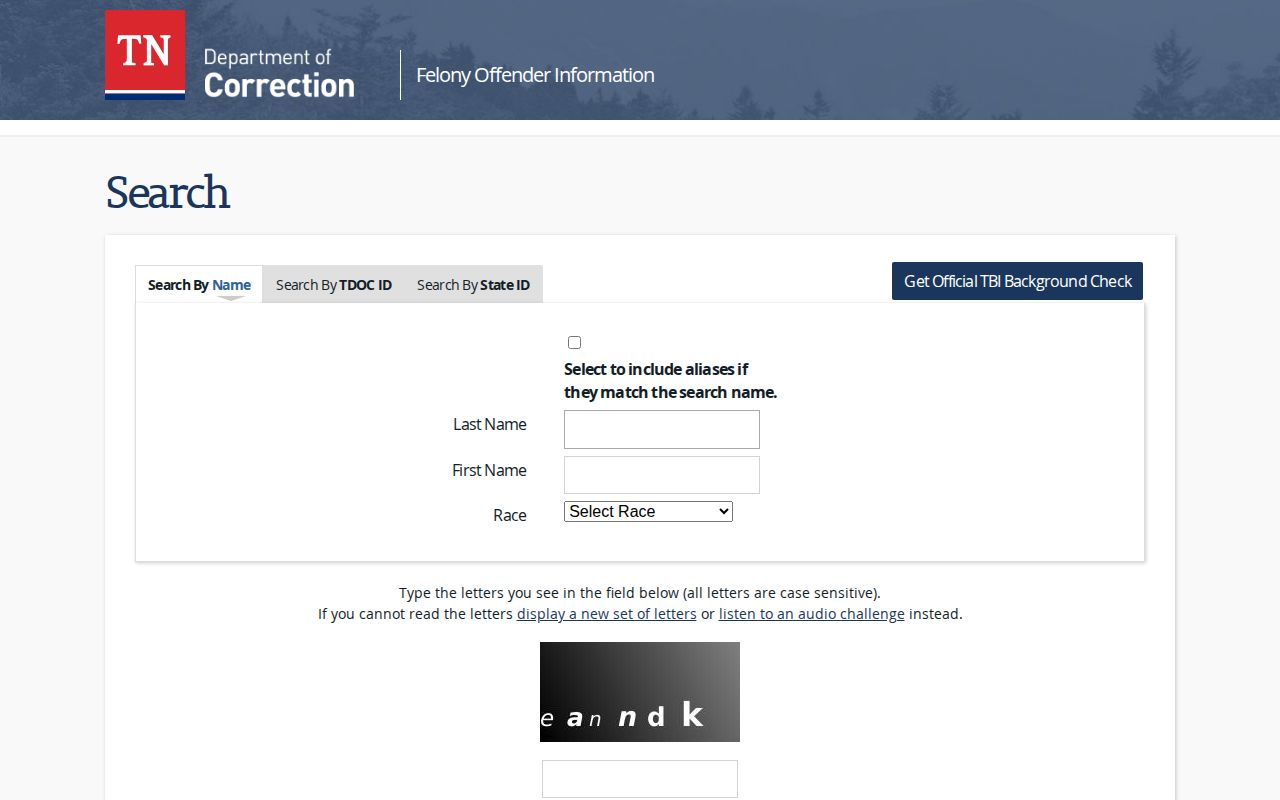
FOIL can remain useful after release because it includes current and former TDOC cases, but its displayed date must be read by its exact label.
Grainger Release Status by System
One search cannot cover every Grainger County release. The sheriff portal, court record, FOIL, VINE, BOP, and ICE each have a defined boundary. A result should be described only within that boundary. “Not in BOP custody,” for example, does not rule out another jail or federal supervision.
| Situation | First source | What confirms the event |
|---|---|---|
| Current Grainger booking | Sheriff jail search | Current matched record and facility confirmation |
| Past Grainger booking | Sheriff records custodian | Movement entry with time, type, and destination |
| Tennessee felony transfer | TDOC FOIL | State location, status, release record, or supervision status |
| Parole or probation | FOIL and the Dandridge field office | Public status plus the correct supervising record |
| Federal sentence | BOP Inmate Locator | Past date or released label, checked for other custody |
| Immigration custody concern | ICE detainee locator | Facility or agency confirmation of status and destination |
Grainger Release Alerts and Transfers
Grainger’s sheriff directly links Tennessee VINELink. VINE can send a custody-event notice after a user registers on the correctly matched person record. It is best used before the expected event. Search by name or offender ID, verify the reporting facility and identity, open the record, and select an offered phone, text, email, app, TTY, or accessibility channel. Complete the live confirmation. If a phone flow asks for a PIN, create a private PIN and use it to acknowledge the call.
The Tennessee VINELink service can provide an event lead, not the full legal reason. An explicit release or out-of-custody event closes the reporting agency’s episode. TDOC policy also recognizes release by detainer to another Tennessee county facility. That is a handoff, so the receiving record must be checked. VINE help is available around the clock at 888-868-4631.
Federal cases require different tools. The BOP Inmate Locator covers federal inmates incarcerated or released from 1982 forward. A recent U.S. Marshals prisoner may not yet appear in BOP, and the federal court’s detention or release order can be the better starting point. The ICE detainee locator concerns current immigration detention and is not a Grainger release archive.
Grainger Court Release Record Route
The Grainger booking detail includes Court Type and Court Date. Those fields help choose the lasting case source. Circuit criminal matters and General Sessions criminal matters use separate dockets. Ask for the bond or release order, disposition, dismissal, judgment, sentence, jail-credit calculation, probation order, revocation material, and any amended order that fits the case.
The court record explains authority, not always the moment of physical release. A dismissal in one case does not remove a second warrant or detainer. A split sentence can combine jail with probation. A judgment may show credit and terms, while the Detention Facility still holds the exact movement time. This two-record method is especially useful when the public jail view changes or an older entry no longer appears.
For a disputed state Release Eligibility Date, TDOC is the timekeeper. Tennessee precedent requires starting with a declaratory-order request to TDOC before a later court challenge. Do not ask the Grainger jail to interpret state sentence law or calculate a new date.
Grainger County Release Facility
Grainger County has one verified local custodial facility. The Grainger County Detention Facility holds adults booked locally, including people awaiting case action and some sentenced prisoners. A person may leave for the community, TDOC, another county, federal custody, or an immigration handoff. The sheriff’s movement entry tells those outcomes apart.
- Grainger County Detention Facility: county jail at the current Justice Center; confirm releases through the sheriff record and supporting court order.
No TDOC prison, BOP prison, dedicated ICE detention center, or separate municipal jail was authoritatively identified inside Grainger County. State and federal locators still matter when the local jail transfers a person out.
Correct Grainger Release Record Errors
Send an error to the office that created the field. A fresh Grainger booking, photo, or movement error belongs with the Sheriff’s Department. A docket, judgment, or expungement issue belongs with the clerk and court. FOIL dates and sentence calculations belong with TDOC, while registry data goes to TBI or the registering agency. Grainger County Archives may help with permanent older county records, but it is not the first office for a recent release.
This routing avoids broad requests and helps preserve the source trail. Identify the exact field, record date, booking or offender number, and correction sought. Attach the controlling order when appropriate. Ask for written confirmation of the agency’s response. For release proof, keep the identity match, source, access date, agency contact, court or movement record date, and destination together.
Note: An absent result may reflect spelling, lag, transfer, retention, sealing, expungement, or the wrong custody system rather than release.