
Grainger Parole and Probation Compared
Parole and probation can both place a Grainger County person in the community under rules, but they begin in different ways. The Tennessee Board of Parole decides discretionary parole after prison. A Grainger County court imposes probation as part of a sentence. TDOC Community Supervision then handles field supervision for both groups. A probation order may avoid prison, follow a county jail term, or form the community part of a split sentence. Parole follows imprisonment and remains subject to Board action.
The label matters because it points to the right record. A court judgment and later revocation orders explain probation. Board files and TDOC records explain parole. FOIL, Tennessee's Felony Offender Information Lookup, may display either status for a felony offender. A county-jail-only misdemeanor case may never appear there.
Determinate release probation is another Tennessee term that can appear in a felony record. TDOC describes it as a statutory release form for qualifying sentences, so the label should not be replaced with ordinary court probation. The sentence, statute, and FOIL record identify which form applies. If a split term begins in the Grainger jail system and ends under supervision, the jail confirms the custody exit while the court and TDOC records explain the probation portion.
| Question | Parole | Probation |
|---|---|---|
| Who authorizes it? | Tennessee Board of Parole after a prison term | Sentencing court through its judgment or order |
| Main public check | FOIL status, Board decision, and certificate record | FOIL when applicable, plus Grainger court judgment |
| Who supervises? | TDOC Community Supervision | TDOC Community Supervision for covered cases |
| How can it end? | Discharge, expiration, or Board action | Completion, discharge, or court action |
- Discharge
- The end of active custody or supervision shown by the responsible agency's record.
- Absconder
- A person alleged to have stopped reporting or complying. It is not the same as discharge.
- Revocation
- A formal process that can return a person to custody after a proven violation.
- Split sentence
- A sentence combining confinement with a later term of community supervision.
Verify Grainger Post-Release Supervision
Start with identity, not a familiar name alone. FOIL covers people currently or formerly in TDOC felony custody or supervision. Its status terms should be read as written. “Parole” or “Probation” indicates community supervision. “Inactive” may mean active TDOC supervision ended, while “Incarcerated” means the person remains confined in a TDOC setting. An absent result does not settle a Grainger County jail case.
- Search FOIL by TDOC ID or State ID when one is known. Otherwise use the full name and check the photograph, offense, and sentence details.
- Record the exact status, location, sentence fields, and date viewed. Do not turn an eligibility date into a discharge date.
- For probation, compare the Grainger County judgment, disposition, and any later violation or revocation order through the Circuit Court Clerk.
- For parole, review Board hearing and decision information. A recommendation or grant still requires an approved plan and certificate before physical release.
- Call the Jefferson and Grainger field office for reporting-office routing. Staff may not disclose private case details to an unrelated caller.
The strongest proof joins the public status with the source that created it. The Grainger County released inmate search and records path explains how to confirm the separate jail movement when supervision begins after local custody.
Grainger Supervision Office in Dandridge
Grainger County has no separately listed TDOC supervision office in Rutledge. The official TDOC field-office directory pairs Jefferson and Grainger counties at the Dandridge location. That local routing fact prevents a common mistake: the Grainger Justice Center is not the probation or parole reporting office merely because it holds the sheriff and courts.
The directory does not publish walk-in hours, a named officer, or one check-in process for all clients. Call first. A reporting instruction in a person's own paperwork controls over general directory information.
Jefferson and Grainger Office
1228 Circle Drive
Dandridge, TN 37725
Phone: 865-471-7890
Fax: 865-397-8377
Hours: Call before visiting
The screenshot below comes from the official TDOC Community Supervision directory.
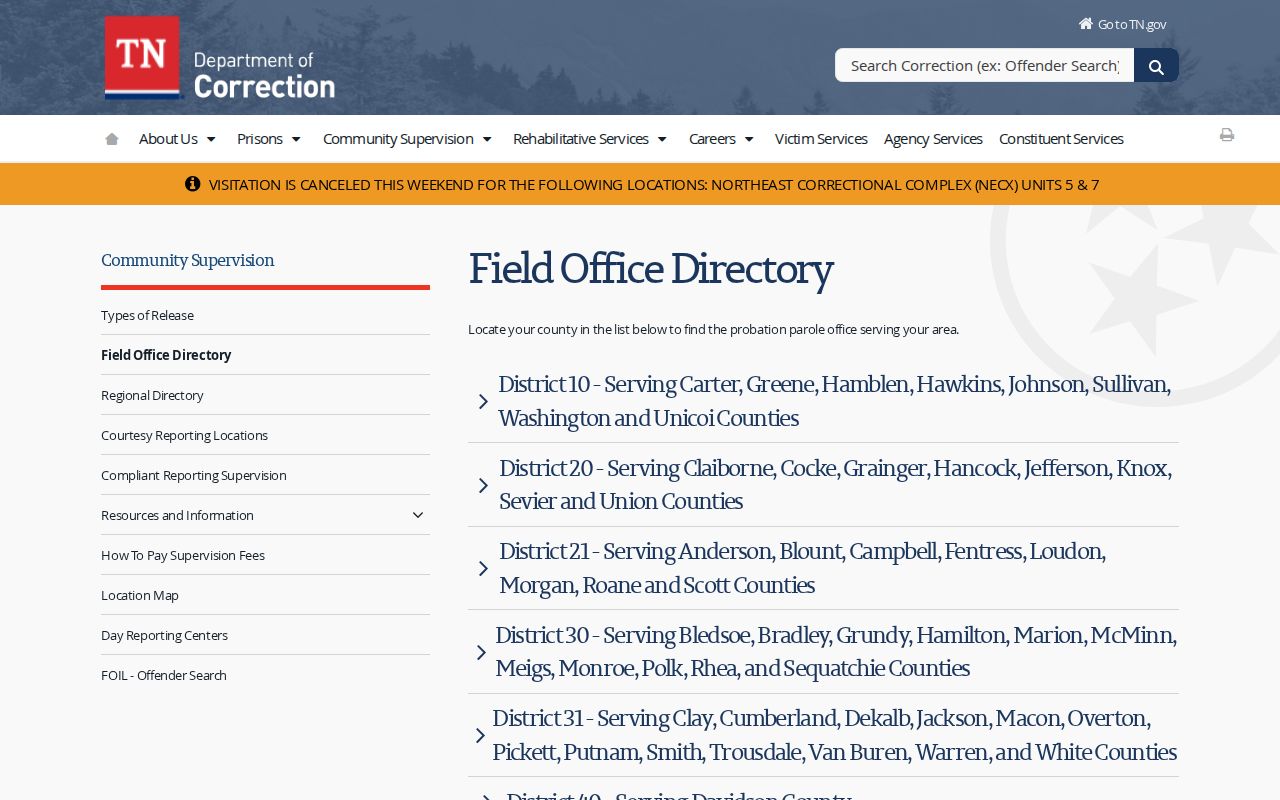
It documents the Dandridge address and phone used for Grainger County supervision routing.
Grainger Supervision Violations and Warrants
Conditions are the rules attached to community supervision. They vary with the judgment, Board certificate, offense, and individual plan. A violation report is an allegation that a rule was broken. It does not itself prove a new offense or end supervision. Probation revocation belongs to the sentencing court. Parole revocation proceeds through the Board's process.
Absconding generally means an alleged failure to maintain required contact or comply with supervision. No public Grainger County absconder list was found. FOIL can show an “Absconded” status in an applicable TDOC case, but anyone trying to confirm a warrant should use the court, Board record, or authorized agency response. VINELink tracks custody events and notifications, not a full record of compliance.
How Grainger Supervision Records Close
Supervision ends through a formal agency or court event, not merely because an old office location disappears from a search. For probation, the judgment, term, later order, and case disposition show whether the court discharged the obligation or took other action. For parole, FOIL status, Board records, the certificate, and TDOC sentence information document the path to discharge. “Inactive” deserves a close look at the dates and sentence detail before it is described as complete.
A records request should target an existing document. Ask the Board for nonconfidential parole-file material or the final disposition. Ask TDOC for the applicable discharge or sentence record. Under the Tennessee Public Records Act, access remains subject to exemptions, agency rules, and the custodian that holds the record. The law does not require an office to create a new supervision summary.
Note: A current FOIL status is useful evidence, but the dated order or agency discharge record best establishes how supervision ended.
Tennessee VINE may send a custody-change notice near the start or end of a supervision episode, but it is not a supervision ledger. A person can remain on parole or probation after release from a jail or prison. Conversely, a person shown as inactive in FOIL may still have a separate county court matter. Keep the records tied to the same offense, sentence, and agency before drawing a conclusion.
Grainger Parole Hearing Records
The Tennessee Board of Parole controls parole decisions, while TDOC calculates release eligibility and supervises people after release. Current prison and county-jail hearing schedules are updated weekly, usually Monday or Tuesday after a Monday holiday, but schedule copies now must be requested by email. Last-minute changes can occur. The Board hearing schedule page gives the current request route and hearing contact.
Board hearing types include grant, revocation, rescission, time-setting, and appeal matters. Hearing officers make recommendations; Board members decide. FOIL result labels such as Continued, Declined, Parole, Revoked, and Serve must be read in that process. “Parole” as a hearing result reflects recommended release to supervision. It does not prove the person has left custody. Board Operations processes the final disposition, and the Certificate Unit issues a certificate after a grant and an approved release plan.
The Board Operations source shown below explains the steps between a favorable decision and release.
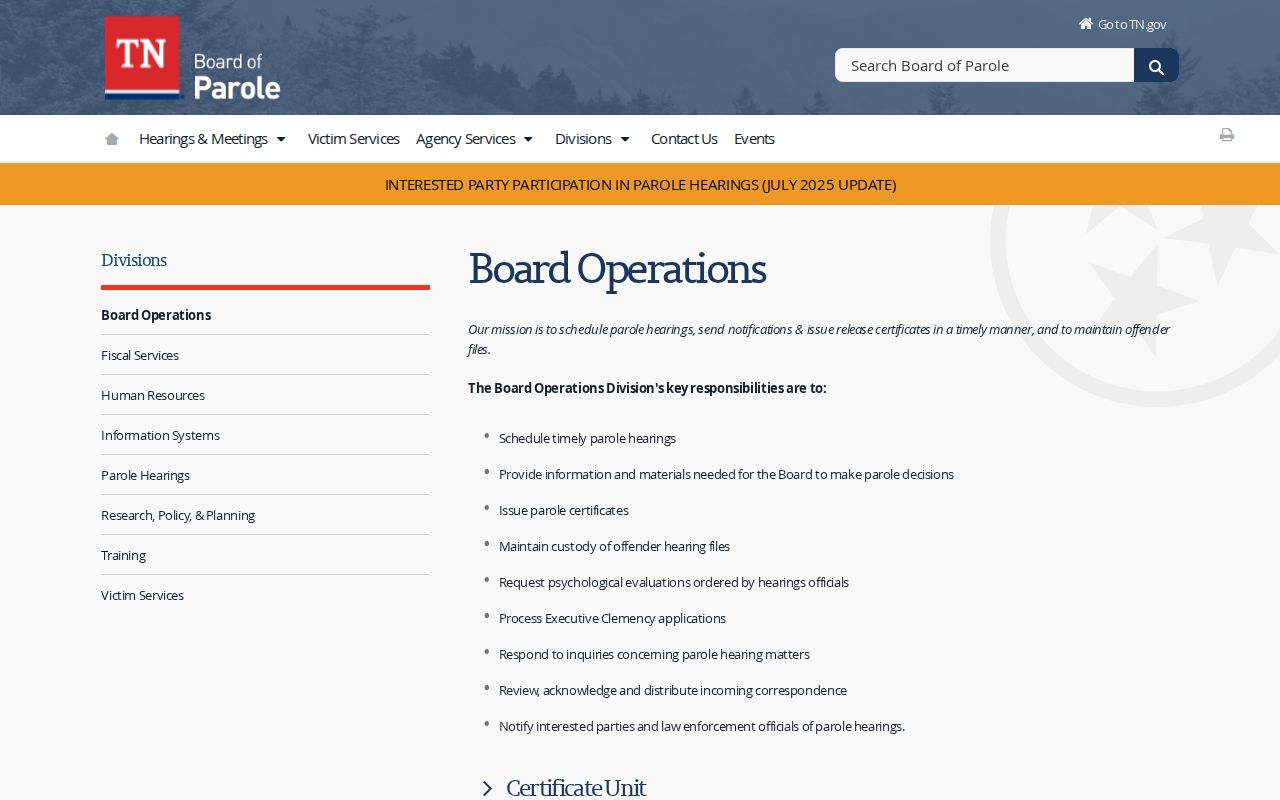
That sequence is why a hearing result must be paired with the certificate and actual custody exit.
Correct Grainger Supervision Record Errors
Fresh errors about a Grainger County jail release belong first with the Grainger County Sheriff’s Department because that office keeps the local movement record. Older permanent county material may be referred to Grainger County Archives, which has limited published days and hours. A court error or missing probation order belongs with the clerk or court that created the case record. These paths should not be mixed with a TDOC sentence-date dispute.
When a TDOC release-eligibility calculation appears wrong, Tennessee precedent requires starting with a declaratory-order request to TDOC under the Uniform Administrative Procedures Act before seeking a declaratory court action. Gather the judgment, offense date, sentence details, FOIL labels, credit records, and any amended order. The office should be asked to correct its own record, not to predict an outcome from incomplete facts.
Grainger County Archives is an older-record referral, not the first source for a current probation or parole status. Its limited public schedule reinforces the need to call before a visit. Recent Board action belongs with the Board; a current field assignment belongs with Community Supervision; and a fresh jail movement belongs with the sheriff. Routing the issue by record owner saves time and reduces the chance that one office's answer is mistaken for another agency's decision.
Note: Keep the source, access date, field label, and agency response together so a later correction can be traced to the proper custodian.