
Grainger Projected and Actual Release
A projected date is a calculation or milestone. An actual release is a completed physical movement recorded by the custodian. Tennessee FOIL uses several precise labels: Sentence Begin Date, Sentence End Date, Parole Eligibility Date, and Parole Hearing Date or Result. They describe different points. The Sentence End Date concerns release from state supervision or incarceration and may reflect credits. The Parole Eligibility Date is the earliest point for parole consideration under the ordered percentage. Neither should be renamed as a guaranteed discharge.
A Grainger County pretrial detainee generally lacks a computed sentence end because no final sentence exists. Bond can make release possible, yet it does not prove that bond was posted or that another hold is absent. A county jail sentence also differs from a TDOC prison sentence. Grainger’s public jail detail system shows admission, charge, court, and bond data, but no release calculation.
A transfer can look like release from one roster while confinement continues. If the Grainger jail sends a sentenced person to TDOC, FOIL becomes the state tracking source. If another county, a federal agency, or immigration authority takes custody, that receiving system controls the next status. The destination field in the movement or release authorization separates a community exit from a custodial handoff.
Find a Grainger Projected Release Date
Begin with custody type. TDOC FOIL covers Tennessee felony custody and supervision, including former cases. It does not necessarily cover someone held only in the Grainger County jail on a misdemeanor or pending charge. Identifiers such as TDOC ID or State ID reduce same-name errors.
- Identify whether the person is in the Grainger jail, a TDOC placement, federal custody, or another jurisdiction.
- For TDOC, search FOIL by ID or name and verify the person through the photo, offense, and sentence details.
- Transcribe the exact date labels, status, sentence structure, and access date. Do not merge eligibility and end dates.
- For a county case, obtain the judgment and court orders, then ask the Grainger jail for its existing release calculation or movement entry.
- Confirm the completed release through the final status, release authorization, or jail movement record.
The Grainger County released inmate records route explains the broader search when a person has left the local jail or transferred into another system.
The image below comes from the official FOIL field-definition source.
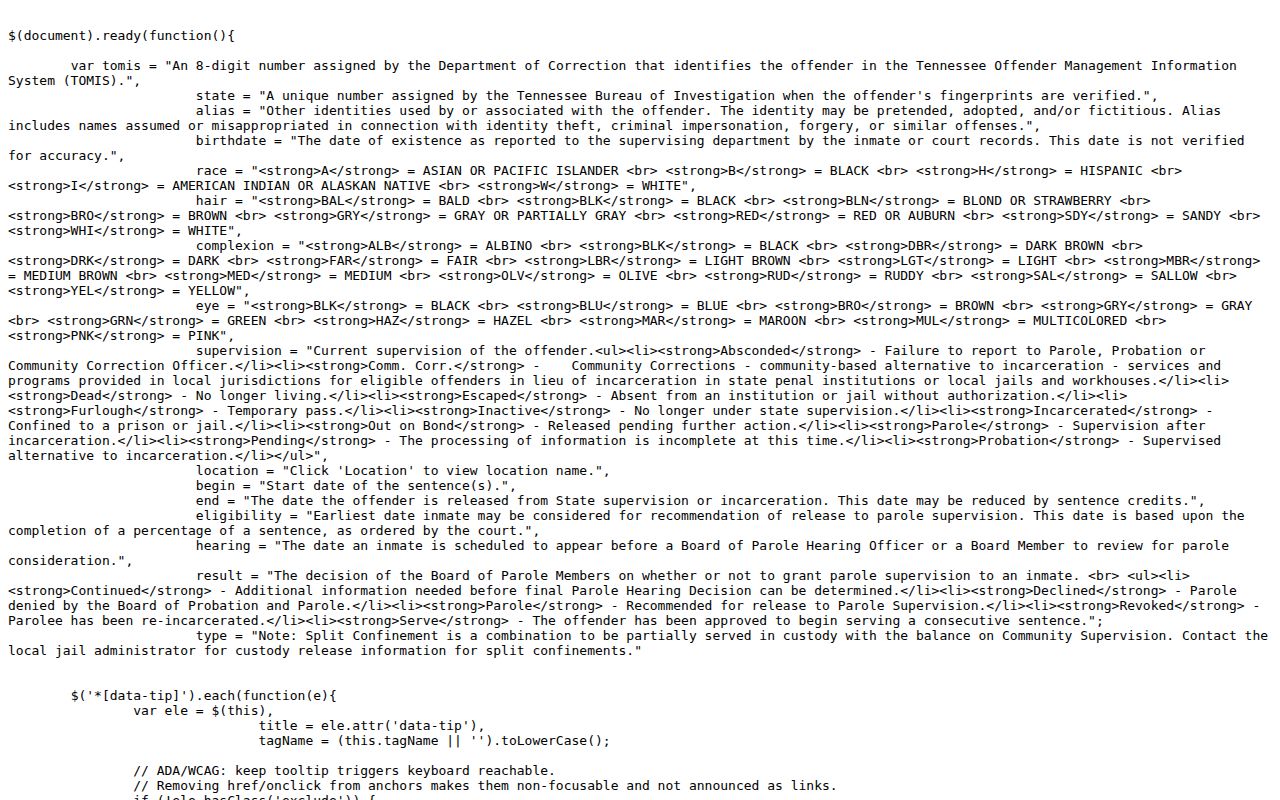
Those definitions keep Sentence End Date and Parole Eligibility Date from being treated as the same date.
Grainger Sentence Credits and Eligibility
TDOC is Tennessee's state timekeeper. Its calculation begins with the judgment, offense date, sentence length, range, alignment of multiple sentences, release-eligibility classification, and any mandatory minimum. Pretrial jail credit and other court-ordered credit are then applied. Consecutive sentences are aggregated, while concurrent terms run together as the judgment directs.
Tenn. Code Ann. § 41-21-236 governs sentence-reduction credits within its eligibility rules, including earning, application, forfeiture, and restoration. Section 40-35-501 governs release eligibility with offense-specific percentages and exclusions. Credits may affect eligibility, the end date, both, or neither, depending on the governing law.
The phrase “serve 85 percent” is not a universal Tennessee rule. The Uniform Judgment Document includes ordinary percentages, designated 85-percent categories, 100-percent service categories, and provisions where credits can allow limited early release without changing sentence expiration. Offense date controls which version applies. A sound check uses the judgment and current code for that offense rather than a broad percentage rule.
Later truth-in-sentencing provisions can require full service for listed offenses committed within their effective period. Earlier structures may apply a different eligibility percentage and limited credit effect. The conviction statute alone is not enough. Confirm the offense date, applicable code version, judgment classification, and any mandatory minimum before interpreting FOIL.
The sentence-credit statute shown below is the manifest-matched legal source.
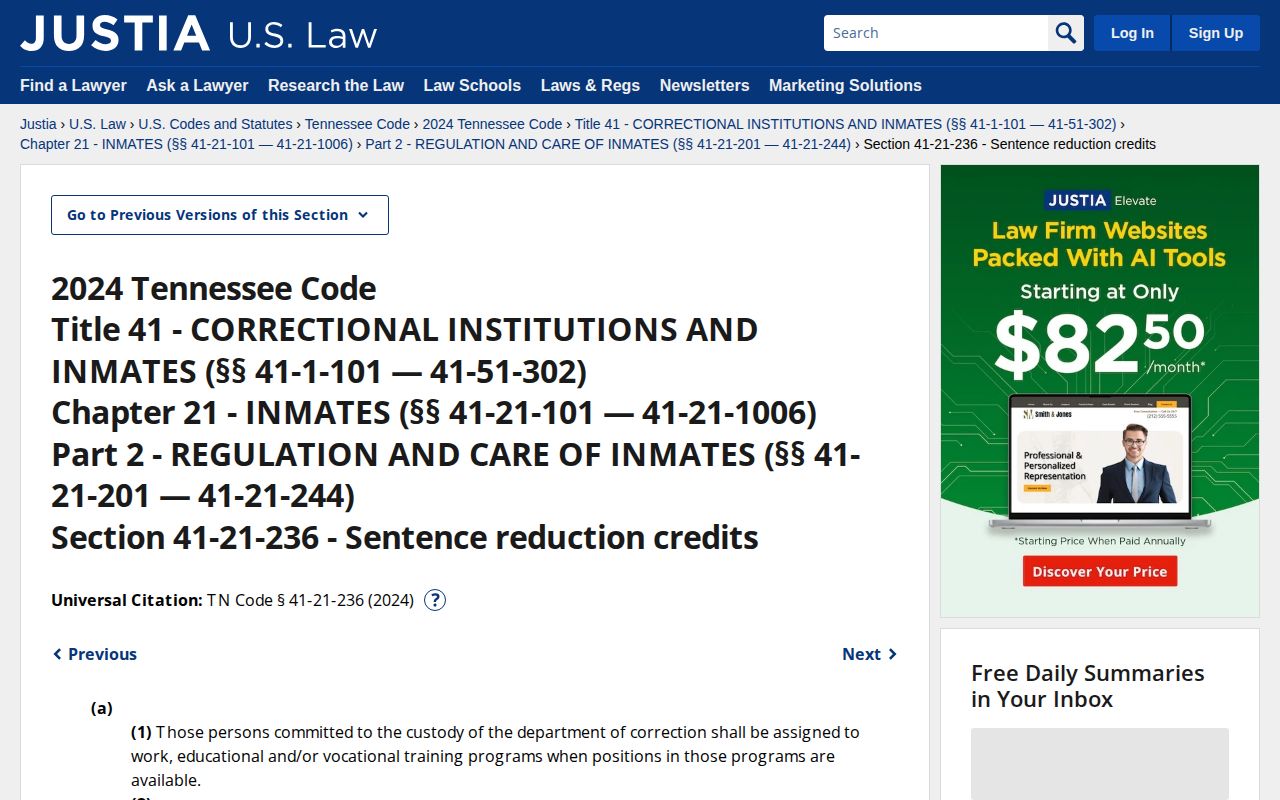
Its rules must be applied to the correct offense and sentence rather than used as a flat deduction.
Why Grainger Release Dates Change
A displayed date can change when the inputs or legal status change. Some changes alter eligibility. Others alter the actual exit while leaving a sentence field intact. Read the newest agency record alongside the judgment.
| Factor | Possible effect | Source to check |
|---|---|---|
| Earned credits | May reduce eligibility or end date where law permits | TDOC credit calculation |
| Credit loss or restoration | Moves a calculated milestone | TDOC disciplinary and credit record |
| Amended judgment | Changes sentence terms or court credit | Sentencing court |
| Consecutive sentence or new case | Extends aggregate custody | Judgments and TDOC sentence record |
| Detainer or hold | Causes a handoff instead of community release | Release authorization and receiving agency |
| Parole decision | Grant, denial, rescission, or revocation affects release path | Board final decision and certificate |
Escape, revocation, corrected credits, and sentence recalculation can also affect the timeline. A public-records request can seek an existing calculation, but it cannot force an agency to perform a new legal analysis.
FOIL carries its own accuracy and timeliness caution. A new court order or restored credit may not appear at once. When the displayed date conflicts with the judgment or a recent order, contact TDOC Sentence Management or the listed institution or supervision office. Keep the label and access time so staff can locate the exact discrepancy.
Confirm a Grainger Release Date
For county custody, use the Grainger County Sheriff’s official contact to call the Detention Facility at 865-828-3613 and ask for the records custodian. A focused request identifies the person and admission date, then seeks the existing movement entry, release date and time, authority or type, and destination. The public portal's Admit Date is not a release date.
For TDOC custody, compare FOIL with the release authorization, sentence record, and listed institution or community-supervision office. TDOC's types-of-release source helps distinguish parole, probation, and other release forms. The screenshot below illustrates that official state route.
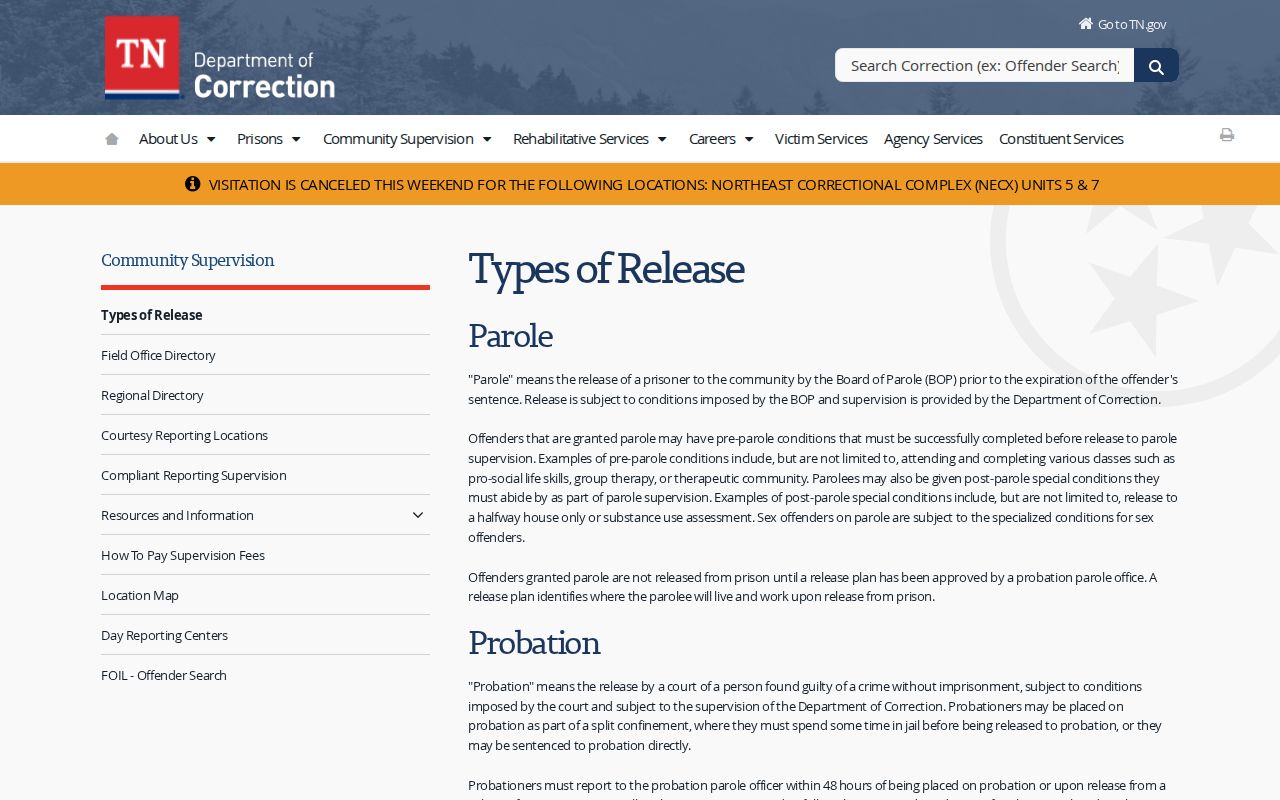
It supports the need to preserve the agency's release label instead of substituting a generic date.
A pending custody event can also be tracked through the Grainger County VINELink Check. The alert remains a lead. Confirm it with the agency that reported the event.
VINELink may report a release or transfer, but the notification does not replace the final release authorization. TDOC's written notice distinguishes release type and can include the sentence-expiration date and intended residence area. When a detainer sends the person to another Tennessee county facility, SAVIN/VINE may continue tracking the receiving episode. That is release from one custodian, not proof of freedom from all custody.
Grainger RED and Parole Timing
The Tennessee Board of Parole calls the eligibility calculation the Release Eligibility Date, or RED. The judge imposes the sentence and classification. TDOC calculates the governing percentage and RED. The Board decides discretionary parole. This division is critical because an eligible person has reached a point for consideration, not a guaranteed exit.
After TDOC reports eligibility, the Board may schedule a grant hearing. A favorable recommendation or grant still does not prove physical release. The release plan must be approved, Board Operations must process the final disposition, and the Certificate Unit must issue the certificate. A pre-parole rescission can also undo a grant before release.
FOIL hearing-result terms need the same care. Continued means more information is needed. Declined means denied. Parole reflects recommended release to supervision. Revoked means reincarceration, while Serve can mean the start of a consecutive sentence. None should be converted into “released” without the final custody record.
Board schedules can also change at the last minute. A hearing date is not a release date, and a public attendance option does not alter that distinction. Ask for the current schedule through the Board's published process, then obtain the nonconfidential final decision when needed. The legal milestone and physical exit remain separate records.
Grainger Jail Release Calculations
A local Grainger sentence does not become a FOIL calculation just because it involves confinement. FOIL's own glossary notes that split confinement combines custody with community supervision and directs users to the local jail administrator for custody-release information. The Grainger jail portal shows charges, court dates, bond, and admission data, but not a computed end date.
Ask the jail for its existing calculation or the court mittimus, which is the order directing custody. Do not calculate a release from the charge label, bond amount, or sentence length alone. Court credit, sentence alignment, later orders, and holds can change the outcome. For a pretrial person, the Grainger County court record and jail must confirm whether an order was carried out.
Grainger's booking detail can still help frame a focused request. Name ID, admit date and time, court type, court date, bond type, confining agency, and charge data identify the correct episode. Ask for redaction of exempt material and the nonexempt remainder rather than a new narrative or calculation.
Note: Grainger County publishes no fixed release-processing time or weekend rule, so direct confirmation is required for the actual exit.
Correct Grainger Release Date Errors
Send each dispute to the record owner. The Grainger sheriff handles errors in a fresh local movement entry. The court handles a wrong judgment or missing order. TDOC handles FOIL and state sentence calculations. Gather the offense date, judgment, credit record, exact FOIL label, access date, and any amended order before requesting review.
If TDOC's RED appears wrong, Tennessee Supreme Court precedent requires beginning with a request for a declaratory order from TDOC under the Uniform Administrative Procedures Act before a declaratory court action. That route is more precise than asking the jail or Board to recalculate a state sentence they do not control.
Preserve the disputed field exactly. A request should name the offender, TDOC or State ID, judgment, offense date, credit at issue, and the date FOIL was viewed. Ask for the existing calculation record and the agency's review of its data. A concise request gives the timekeeper a clear record trail while avoiding an unsupported release estimate.